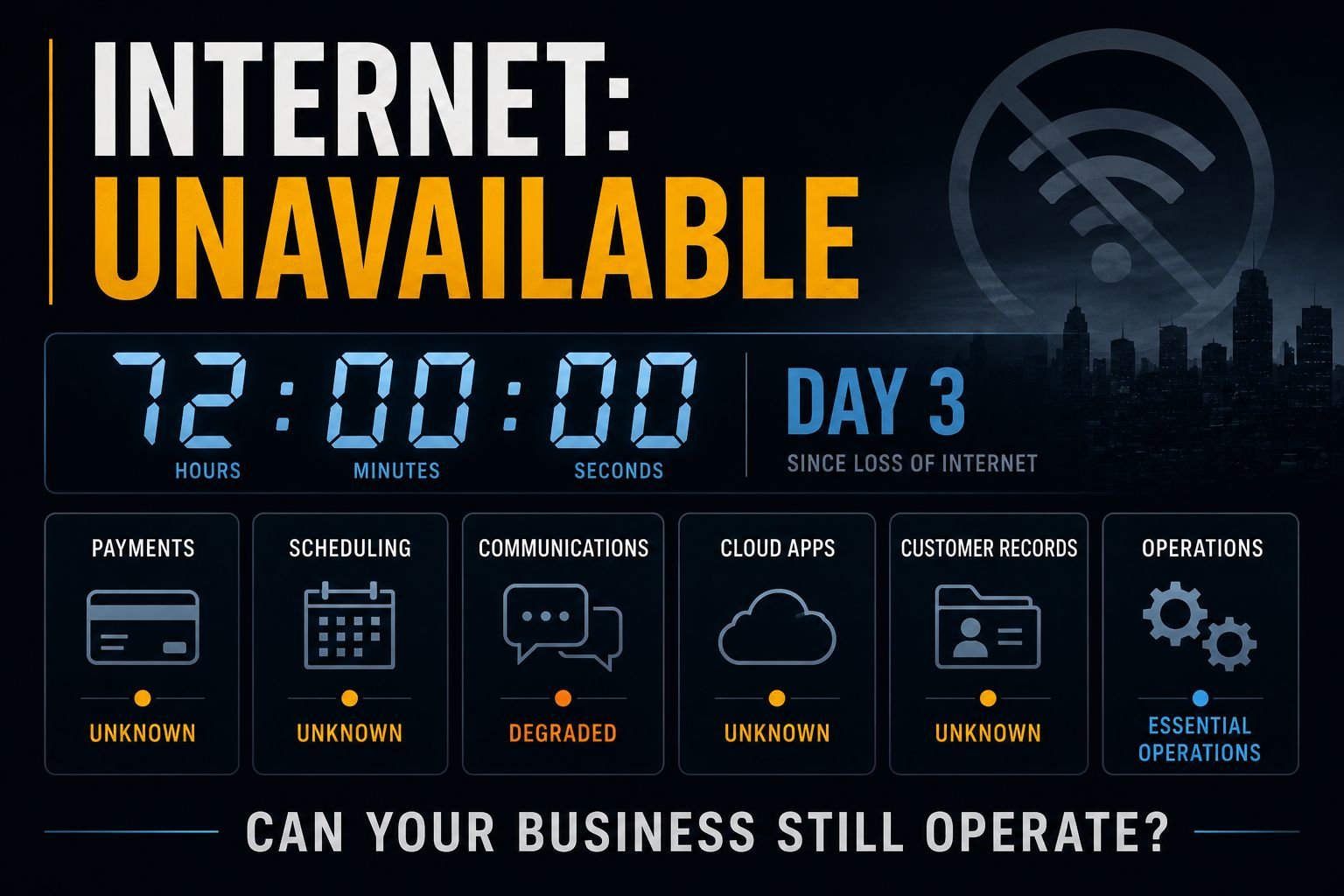
Could Your Business Operate for Three Days Without the Internet?
Most businesses have experienced an internet outage.
Usually, it's annoying. People complain. Someone checks the router. Someone else calls the provider. Maybe employees use their phones as hotspots for a while.
Then the internet comes back and everyone gets on with the day.
But what if it didn't?
Imagine arriving at work tomorrow morning and discovering your internet connection is unavailable.
Your provider can't give you a restoration time.
By noon, it's still down.
The next morning, it's still down.
Three days later, you're still waiting.
Could the business keep operating?
The Internet Isn't Just the Internet Anymore
For many organizations, losing internet access means losing access to much more than websites and email.
Scheduling may be online.
Customer or patient information may live in a cloud application.
Accounting and payroll may be cloud-based.
Employees may communicate through Microsoft Teams, Slack, email, or another online platform.
Phones may use VoIP.
Payments may depend on internet connectivity.
Critical documents may live in Microsoft 365, Google Workspace, or another cloud service.
Vendors may require online ordering.
Employees may need internet-based authentication to access other systems.
One lost connection can affect several parts of the business at the same time.
That creates an operational question alongside the technical one.
IT needs to know:
When will the internet be restored?
The business also needs to know:
Can we keep operating until it is?
Four Hours Is Different From Three Days
An organization may function reasonably well through a short outage.
Employees improvise. Work gets deferred. People use phones. Someone writes something down instead of entering it into a system.
For a while, that may work.
Then the outage continues.
Customer requests accumulate. Transactions still happen. Information changes. New work arrives. Employees still need direction.
What looked manageable at hour two may look very different the next morning.
That's one of the problems with using past outages as evidence of resilience. Getting through a two-hour internet outage doesn't necessarily tell you what happens when the disruption lasts two days.
Duration changes the operational problem.
Technology Failure Becomes a Business Problem
An internet outage is easy to think of as an IT problem because the thing that failed is technology.
But the consequences don't stay inside IT.
A restaurant may lose online ordering or payment capability.
A medical practice may lose access to cloud-based patient information.
A construction company may lose access to schedules, plans, communications, or vendor systems.
A professional services firm may suddenly discover that nearly everything employees need to serve clients lives online.
The technical cause may be identical.
The operational consequences can be completely different.
That's why practitioners working with digitally dependent organizations need to look beyond whether technology can be recovered.
Recovery matters enormously.
So does what happens to the organization while everyone is waiting for it.
Recovery Is Only Part of the Problem
Cybersecurity, disaster recovery, business continuity, incident response, and operational resilience all provide important ways to prepare for disruption.
But there is still a period organizations have to get through:
The time between losing critical technology and getting it back.
Technical teams and providers may be working around the clock to restore service.
Meanwhile, the business still has customers. Employees still need direction. Essential work may still need to happen.
Some organizations may be able to continue for days.
Others may discover that serious operational problems begin within hours.
Finding that out during the outage is an expensive way to learn.
This Is the Resilience Gap™
At Calm Under Attack™, I use the term Resilience Gap™ to describe a problem I see in increasingly technology-dependent organizations:
Our dependence on critical technology has grown faster than our ability to operate without it.
The internet is an obvious example, but it isn't unique.
Cloud platforms, telecommunications, identity systems, critical vendors, business applications, endpoints, artificial intelligence, and other technologies have become embedded in everyday operations.
That dependence isn't inherently bad. It makes modern organizations faster and more capable.
It also means technology failure can become operational disruption remarkably quickly.
That's the problem Operational Survival™ is concerned with.
A Practitioner Question
If you work in cybersecurity, IT, business continuity, resilience, risk, managed services, or operations, think about the organizations you support.
You probably know quite a bit about their technology.
You may know how they protect it, monitor it, support it, and recover it.
Here's another question worth having in the resilience conversation:
If the internet disappeared tomorrow morning and stayed unavailable for three days, could the organization keep doing what matters until it came back?
If the answer isn't clear, you've found the territory Operational Survival™ was created to address.
Explore Operational Survival™ With Other Practitioners
The Calm Under Attack™ Lab is a community for practitioners exploring how organizations can prepare for the day critical technology fails.
We discuss real-world disruptions, professional perspectives, and the developing practice of Operational Survival™.
Join the Calm Under Attack™ Lab →