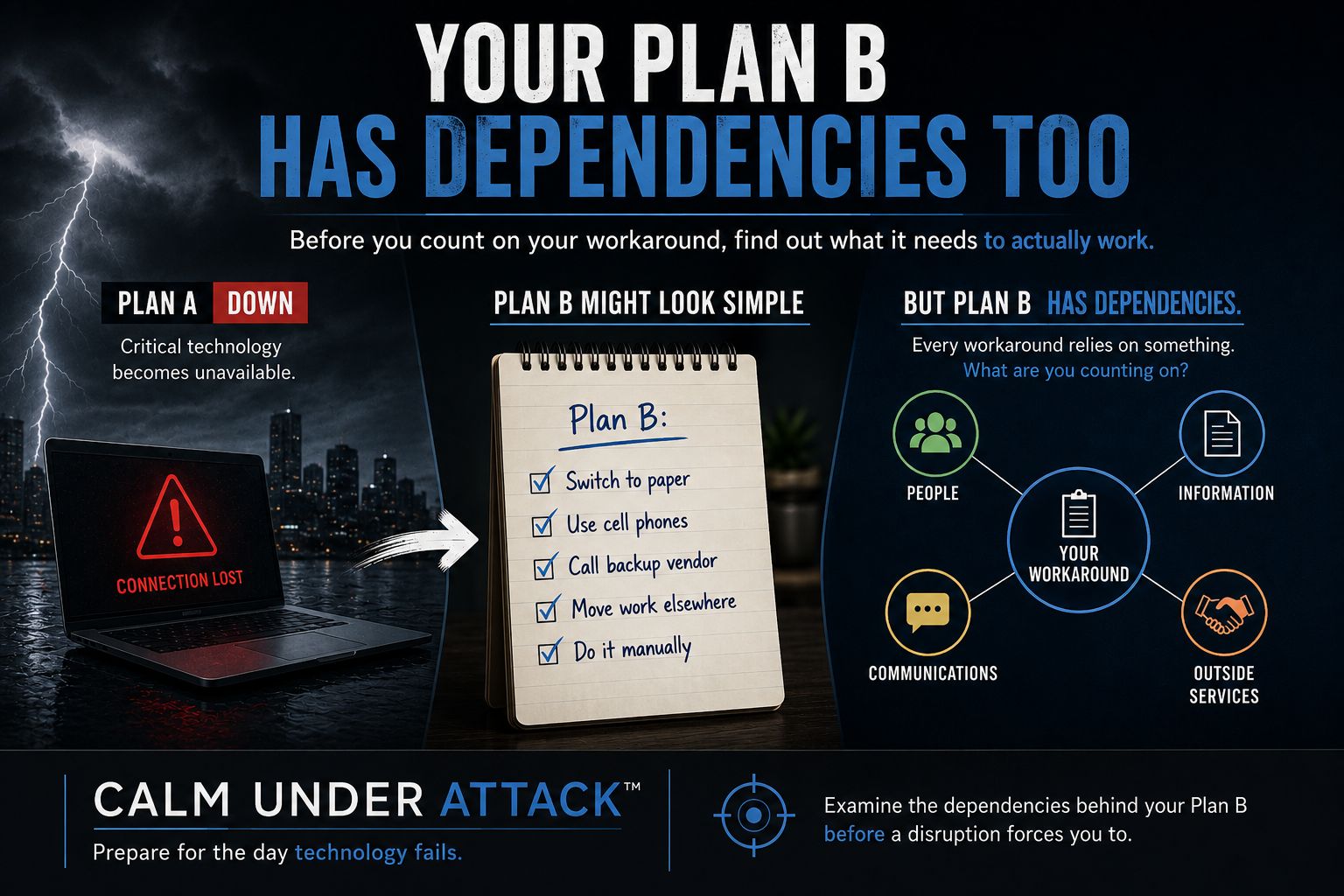
What Happens When Plan B Fails Too?
Practitioner Brief
When critical technology becomes unavailable, organizations often have a reassuring answer:
We'll use the workaround.
Maybe that means switching to paper, using another communications method, moving work somewhere else, calling customers instead of using the portal, or relying on an alternate provider.
Those may all be reasonable plans.
But writing down an alternative way of working and being able to operate that way during a real disruption are two different things.
Sometimes Plan B has problems of its own.
“We'll Just Do It Manually”
Manual processes are one of the most common answers to technology disruption.
If the system goes down, we'll use paper.
If the application isn't available, we'll use a spreadsheet.
If the portal doesn't work, we'll call people.
If automation stops, employees will do the work manually.
Maybe they can.
The problem is that many organizations haven't operated that way in years. Employees change. Processes change. Technology becomes more deeply embedded in the work.
A manual alternative that made perfect sense when a continuity plan was written may be far less practical today.
That's easy to miss when normal technology is available.
A Workaround Isn't the Same as Operational Capability
A sentence in a continuity plan can make an organization feel prepared:
“If X is unavailable, we will use Y.”
But the existence of Plan B doesn't tell you how well the organization will actually operate when it has to use it.
Real disruptions are messy.
Work continues to arrive. Employees still need information. Customers still have expectations. Decisions still have to be made. Conditions change. What works initially may become harder to sustain as the disruption continues.
That doesn't mean the workaround was a bad idea.
It means the ability to operate through disruption deserves as much attention as the existence of the plan.
Technology Has Changed the Meaning of “Manual”
There's another complication.
Modern work is so digitally connected that supposedly manual alternatives may not be as independent of technology as they appear.
Employees who aren't using the primary business application may still need digital information.
Alternate communications may still rely on technology.
A different location may still need connectivity.
An outside provider may have technology requirements of its own.
Even experienced employees may discover that a process they once performed manually has changed substantially since the last time they did it.
This is one reason Operational Survival™ looks at the business consequence of technology failure rather than stopping with the technical outage itself.
The organization may have an alternative on paper and still struggle to deliver when normal capability disappears.
Short-Term Improvisation Can Be Misleading
Organizations are often remarkably good at improvising during short disruptions.
People find ways around problems. Employees use personal knowledge. Managers make exceptions. Work gets deferred. Everyone pitches in because they expect the problem to be temporary.
Then the outage continues.
What worked for the first few hours may become increasingly difficult as normal business continues around it.
Getting through a short outage is useful experience.
It isn't necessarily proof that the organization can sustain essential operations through a longer one.
Why This Matters for Practitioners
Cybersecurity, IT, business continuity, resilience, risk, managed service, and operations professionals all encounter organizations with documented alternatives for technology disruption.
The professional challenge is recognizing that having a Plan B and having Operational Survival capability aren't automatically the same thing.
That's an important distinction.
The objective isn't to make organizations suspicious of every continuity plan they have.
It's to help them become more confident that when normal technology disappears, essential work can still move.
That's part of the territory Operational Survival™ addresses.
The Operational Survival System™
The Operational Survival System™ gives experienced practitioners a structured methodology for helping organizations prepare for technology disruption from an Operational Survival™ perspective.
The detailed process for evaluating alternatives, identifying operational fragility, and determining where greater preparation is needed belongs inside the practitioner methodology.
The public question is much simpler:
If Plan A disappears, how confident are you that Plan B can actually carry the operation?
That's worth knowing before the organization has to depend on the answer.
Practitioner Reflection
Think about the organizations you support, protect, advise, or serve.
Most probably have some version of Plan B for important technology disruptions.
The existence of that plan is reassuring.
How confident are you that the organization could actually operate with it during a real disruption?
That's a conversation Operational Survival™ practitioners should be prepared to help organizations have.
Technology will fail. Organizations don't have to.
Explore Operational Survival™ With Other Practitioners
The Calm Under Attack™ Lab is a community for practitioners exploring the developing practice of Operational Survival™ through real-world disruption cases, professional discussion, and lessons from the field.
Join the Calm Under Attack™ Lab →